This theme allowed me to gain skills in an area I was
unfamiliar with, of sculpture and specifically plaster casting. I enjoyed the
process of creating plaster casts in the workshop and returned with the idea to
create casts of Barbie dolls in relation to the theme of art and reproduction.
The use of the Barbie doll was key to the theme, with the iconic doll continuously
being reproduced, but also the dolls in plaster have connotations of slaves
which linked to the research into Plato’s cave theory with humans like slaves,
only seeing reproductions of reality. The process of casting also links to
reproduction with the process requiring continuously returning and reproducing
the same process of dripping the wax, painting layers of latex to create the
mould and then ultimately the process of reproducing the doll with the plaster.

Showing posts with label Art Practice 1B Art and Reproduction. Show all posts
Showing posts with label Art Practice 1B Art and Reproduction. Show all posts
Monday, 27 April 2015
Art and Reproduction Evaluation

Thursday, 23 April 2015
.JPG)


Monday, 13 April 2015
Art and Reproduction Revisited
Following the completion of work for 'Art and Text', I have decided to revisit the work I produced for the theme 'Art and Reproduction'. Although I was pleased with the work produced in this theme, I still felt that the idea could be developed further.
In order to develop the work, I will experiment covering the plaster sculptures in paint, by dripping and pouring the paint over the sculptures, as well as dipping the sculptures in the paint to see what effects can be achieved. Adding colour to the sculptures will give another layer of depth to the dolls, and the methods I use to cover them will replicate and enhance the dripping pattern of the wax used to cast them. This also builds on the idea of layer and texture already explored in the project, as I continue to add layers, through the medium of paint, to the sculptures.
In order to develop the work, I will experiment covering the plaster sculptures in paint, by dripping and pouring the paint over the sculptures, as well as dipping the sculptures in the paint to see what effects can be achieved. Adding colour to the sculptures will give another layer of depth to the dolls, and the methods I use to cover them will replicate and enhance the dripping pattern of the wax used to cast them. This also builds on the idea of layer and texture already explored in the project, as I continue to add layers, through the medium of paint, to the sculptures.
Monday, 2 March 2015
.JPG)
.JPG)
.JPG)
.JPG)
Group Crit
Wax dolls-
- Something religious about wax doll- looks like Virgin Mary.
- Looks flurescent, like it would glow in the dark- reminicent of cartoon monsters.
Plaster dolls-
- Like trophy awards at Oscars.
- Importance of the pose; calming pose, could appear like wings (links to religious ideas) frozen hands.
- Head without makeup; like a baby, looks tribal- tribal mask, African tribal head, melted body.
- Narrative emerging from object.
- Innocence of white, frozen calming pose.
Plaster dolls as a group-
- Become units.
- Slaves, killed, burnt.
- Repetition, loses history, meaning, becomes less special, less valuable, less unique.
- Repetition also suggests the importance of the original.
Saturday, 28 February 2015
Final Sculptures
.JPG)
.JPG)
These are the images of my final sculptures, I found this project I huge success. After the first tutorial with Dave I was left really interested with the theme of Art and Reproduction but was confused about how to portray any ideas through sculpture. The casting workshop with Rob really engaged me in the possibilities of creating sculptures through casting and inspired my research into artists that use plaster casting in their sculptures. The idea I decided to pursue required a lot of persistence and continuing visits to the workshop over the period of the four weeks in order to create the five moulds as was set in the criteria, but in the end I created a set (or mini army) of sculptures that have interested me and shown my progress with using many casting techniques for the first time.
This exploration has really opened my mind to the potential of sculpture in my art which I had previously found overwhelming as I had kept in my comfort zone of painting and drawing. I look forward to exploring sculpture further and taking advantage of the resources available.
Friday, 27 February 2015
Week 3 Creating Sculptures
Once the latex had dried by the third week I needed to create a two-part mould over the latex which would be removed and used to secure the latex as the plaster was being poured in and setting. This required estimating how the mould would have to shape around the latex to be easily removed and re-applied. The problems I found once I had removed the two-part mould was trying to remove the latex from the dolls. As I suspected it damaged the wax beneath by pulling it off with the latex and it even caused one of the dolls heads to fall off (though I found this interesting due to the significance of the contrast of the head and body in this project), so I was glad I kept one doll as wax in order to preserve that stage of the process.
The last image shows the plaster poured into the latex mould being supported by the two part mould around it.
.JPG)
.JPG)
.JPG)
.JPG)
.JPG)
Saturday, 21 February 2015
Week 2 Creating Sculptures
The process of covering the dolls in latex was equally as time consuming as building up the layers of wax. I first had to secure the dolls to boards using moulding wax, as well as fill in any large gaps or over hangs from which the latex could not be removed from after setting. Then I started coating them in the first layer of latex, I continued with a further 5-6 layers of the period of the week to allow the latex to be really strong and able to be removed from the dolls and make casts from.
.JPG)
.JPG)
.JPG)
Wednesday, 18 February 2015
Week 1 Creating Sculptures
Firstly, I needed to remove the hair from the dolls, so that the object was completely smooth to allow the latex moulds to peel off from the dolls. I photographed this stage, and continued to do so throughout the process, because at each stage they created an interesting new piece and I wanted to capture the development.
I also began the first few layers of wax, which as can be seen it required many in order to have a more solid and less recognisable figure. By dripping the hot wax from the head down it created the sense of the doll melting and it obscured any noticeable features of a human other than the face, linking to Plato's Cave theory of people like slaves only able to see shadows of the pure object- the doll is manipulated, so the object is recognisable but not in it's pure form. Furthermore, the lack of identifying features gives the dolls the appearance of slaves, further linking to the theme I have explored of Plato's theory.
At this stage I decided to leave one of the three dolls in it's wax form, rather than covering it in latex to create moulds, because I found the wax sculptures interesting in their own right. The contrast of the skin colour and facial features which can still be seen through the thin layer of wax on the head against the opaque layer of wax over the body that distorts all sense of what is beneath it.


Monday, 9 February 2015
Research Following Plaster Workshop
When researching sculptures that work with plaster and casting I found the artist Laury Dizengremel and was drawn to her series of scultures- 'Artists of the Silk Road' an installation sculptures Created between May 2006 in China and August 2006 in England. I like the clarity of the face in contrast to the vague representation of the body. This reminds of Plato's Cave Theory, with people like slaves in a cave, this idea of slavery is captured in the lake of identifying features, as well as the way the body seem to slump to the floor.

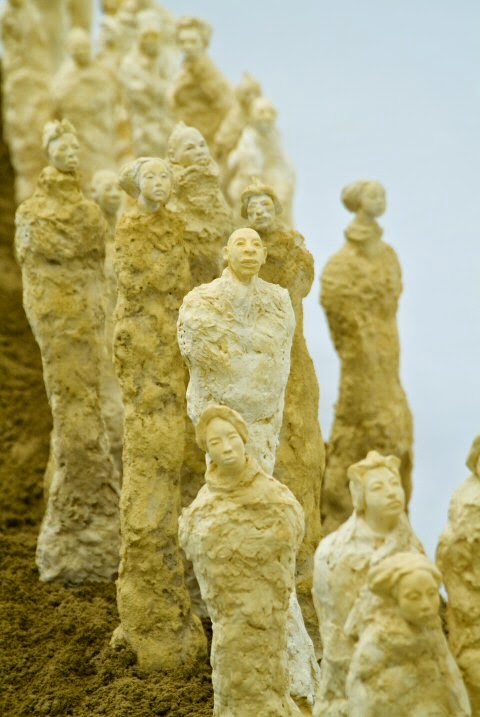
Ideas-
- Use small dressmakers dummy or small dolls (eg. barbies. Could find in charity shops) and sculpt using clay then layers of latex to create a mould to cast from. Pros- latex will be able to produce many casts. Cons- time it take to create latex mould. Also, all moulds will be almost identical, is this pro or con?
- Use more than one model to create different moulds.
Plaster Workshop
For this workshop we explored many different methods of creating casts and moulds. We started by creating a two part mould using (bandage). We also started creating a latax mould, which requires many layers of latax being painted over the object. As well as, a mould of the fruit by pushing it into plaster that has been poured into a square box, then allowing that to set and pouring more plaster on top.


Tuesday, 3 February 2015
Art and Reproduction Task
Task:
You must produce a series of 5 cast reproductions of different objects in different media. Together these cast objects must explore some of the issues we have discussed during the intro session. Pairs of words below can act as starting points for your investigations. You will be taught how to cast using various mould making techniques with Rob and cast in different materials during workshop sessions. You are expected to work independently in the studios and workshops over the next three working weeks.
Prompts:
Geometry/Nature
Technology/Control
Beauty/Hold
Surface/Anxiety
You must produce a series of 5 cast reproductions of different objects in different media. Together these cast objects must explore some of the issues we have discussed during the intro session. Pairs of words below can act as starting points for your investigations. You will be taught how to cast using various mould making techniques with Rob and cast in different materials during workshop sessions. You are expected to work independently in the studios and workshops over the next three working weeks.
Prompts:
Geometry/Nature
Technology/Control
Beauty/Hold
Surface/Anxiety
Monday, 2 February 2015
Art and Reproduction Introduction


Earliest Reproduction
Cave painting is the earliest form of reproduction dating approximately 17,300 years ago.
-Ritualistic: Trying to make the next hunt more successful.
-Documentation: The recording of a successful hunt.
What to consider about reproducing...
Is it the thing itself containing the spirit of the object or a representation of the thing?
Magical or logical?
Greek and Reproduction
The allegory of Plato's Cave is a metaphysical theory of a world beyond the world we see, with humans like prisoners in a cave. To Plato, everything is a reproduction, with art being the furthest from the pure form. Plato's theory is one of a hierarchy suggesting humans are below 'The One' and see only a shadow of the object, a vague representation of the real thing. The hierarchy is as follows:
The One
Geometry and Trigonometry
Pure form
Object in the real world
Reproduction of objects (art)
The importance of Plato's theory is still significant today, with the idea that art is an imitation of what already is an imitation resulting in the need to validate art in some way. However, Aristotle had a higher opinion of art, thinking art can help us understand the world. Where art strikes a balance between being not too real but real enough.
15th Century and Reproduction
The 15th Century held the development of the 'Mathmatical Linear Perspective'. The shift towards science rather than religion.
Technology Development and Reproduction
Iconoclasm
Iconoclasm meaning the destruction of an image was coined about 500-600 years ago. The busiest period was the conflict between Catholics and Protestants
Subscribe to:
Comments (Atom)